

Key takeaways
- Inspect on a warm, calm day, usually every 7–10 days in the active season, and less often in cold or rainy weather.
- Work slowly and gently from the side of the hive, with a little smoke and a clear plan.
- Every time, check five things: queen and eggs, brood, food, space, and health.
- Write down what you see. Records turn inspections into knowledge.
Opening a hive is how you find out what your bees need. But every inspection also disturbs the colony, chills the brood and can trigger robbing, so the aim is to be quick, calm and purposeful. Here’s how.
When to inspect
- How often: about every 7–10 days in spring and during honey flows, when colonies grow fast and may prepare to swarm. In the monsoon and in cold weather, inspect less often and more briefly.
- Time of day: late morning to early afternoon on a warm, still day, when many foragers are out.
- Avoid: rain, strong wind, cold mornings and evenings, and periods of robbing during a dearth.
Asian honeybees (Apis cerana) are more easily disturbed than European bees and may abscond if inspected too often or roughly. Keep their inspections short, gentle and less frequent.
Before you open the hive
- Know why you are opening it. “Check for queen cells and add a honey box” is a better plan than “have a look”.
- Wear your veil and suit, and light your smoker properly so it produces cool, white smoke.
- Have your hive tool, a spare frame or box, and your notebook ready.
- Watch the entrance for a minute. Busy foragers carrying pollen are a good sign; fighting, dead bees or very little activity tell you to look carefully.
Step by step
- Stand to the side of the hive, never in front of the entrance.
- Puff a little smoke into the entrance, wait half a minute, then gently lift the lid and puff a little under it. Use smoke sparingly; too much upsets bees.
- Remove the outer frame first, usually one with little brood, and lean it carefully against the hive. This gives you room to move the other frames without crushing bees.
- Lift each frame straight up, slowly, holding it over the hive so that if the queen falls, she falls back in.
- Look at both sides, turning the frame like the page of a book, and keep it upright so that fresh nectar doesn’t drip out.
- Put frames back in the same order and orientation, gently pushing them together, and close the hive.
The whole inspection should take no more than 10–15 minutes.
The five things to check
1. Queen and eggs
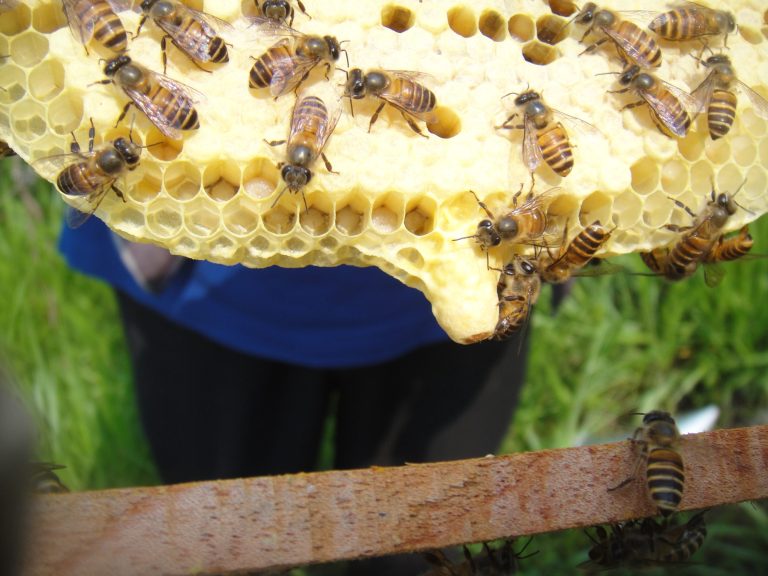
You don’t need to see the queen. Eggs, tiny white upright grains at the bottom of cells, show that she was laying within the last three days. No eggs and no young larvae may mean the colony has lost its queen.
2. Brood
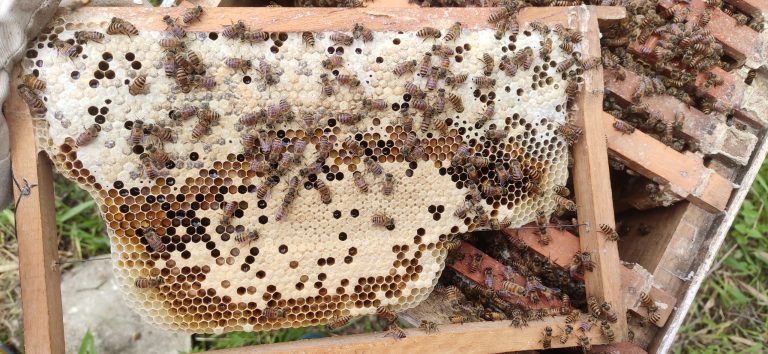
A healthy brood nest has a compact pattern of capped brood, with pearly white, C-shaped larvae in open cells. A scattered, “pepper-pot” pattern, sunken or holed cappings, or discoloured, twisted or sac-like larvae can signal a failing queen or disease. See Pests and Diseases.
3. Food
Check that there is honey (usually above and around the brood) and pollen (colourful packed cells next to the brood). Before the monsoon or winter, make sure stores are enough to get the colony through, and feed if frames are light.
4. Space
Is the colony running out of room? If most frames are covered with bees and filled with brood and honey, add frames or a honey box before they need it. Crowding is the main trigger for swarming.
5. Signs of swarming and problems
- Queen cells along the bottom edges of frames often mean swarm preparation. See Swarming.
- Mites on bees or in drone brood, wax moth webbing, or hornets hunting at the entrance all need action.
- An unusually aggressive colony may have lost its queen, or be under attack or being robbed.
Not sure what you’re looking at? Inside the Hive explains what queens, workers, drones and brood look like.
Keep simple records
After every inspection, note:
| What | Example |
|---|---|
| Date and weather | 12 Falgun, sunny, warm |
| Queen | Eggs seen, queen not seen |
| Brood | 5 frames, good pattern |
| Food | 2 frames honey, pollen coming in |
| Space | Added a honey box |
| Problems | 2 queen cups, no eggs in them |
| Temper | Calm |
A page per hive in a notebook is enough. Over a season, you’ll see each colony’s story, and you’ll know which queens to raise new colonies from.
Check yourself for stings afterwards, and scrape out any stinger with a fingernail rather than squeezing it. If you ever have a reaction away from the sting site, such as difficulty breathing, swelling of the face or throat, or dizziness, get medical help immediately.