
Key takeaways
- Swarming is how a colony reproduces: the old queen leaves with about half the bees to start a new home.
- It usually happens in spring, when colonies are strong and crowded.
- Watch for queen cells along the bottom edges of frames, and give colonies space before they need it.
- Making a split gives the bees what they want, a new colony, without losing half your workforce.
- Absconding, common in Apis cerana, is different: the whole colony leaves because conditions are bad.
There are few sights in nature as dramatic as a swarm: thousands of bees pouring out of a hive and swirling in the air, then settling as a humming cluster on a branch. For the bees, it’s a sign of success, as the colony is strong enough to reproduce. For the beekeeper, it means losing half the bees, and most of the season’s honey crop with them.
Why bees swarm
A single honeybee colony reproduces by dividing. When a colony is strong and well fed, especially in spring, it raises several new queens. Just before they emerge, the old queen leaves with roughly half the workers. The swarm settles nearby while scout bees search for a new home, and the colony left behind continues with one of the new queens.
The main triggers are:
- Crowding: too many bees and too little space for the queen to lay or for nectar to be stored.
- A strong spring build-up: plenty of food and a rapidly growing population.
- An older queen, whose pheromones spread less well through a crowded hive.
- Genetics: some colonies are simply more inclined to swarm.
In Nepal, the main swarming season is spring (Falgun to Baisakh), though swarms can happen at other times during strong flows. See Nepal’s Honey Calendar.
Signs a colony is about to swarm
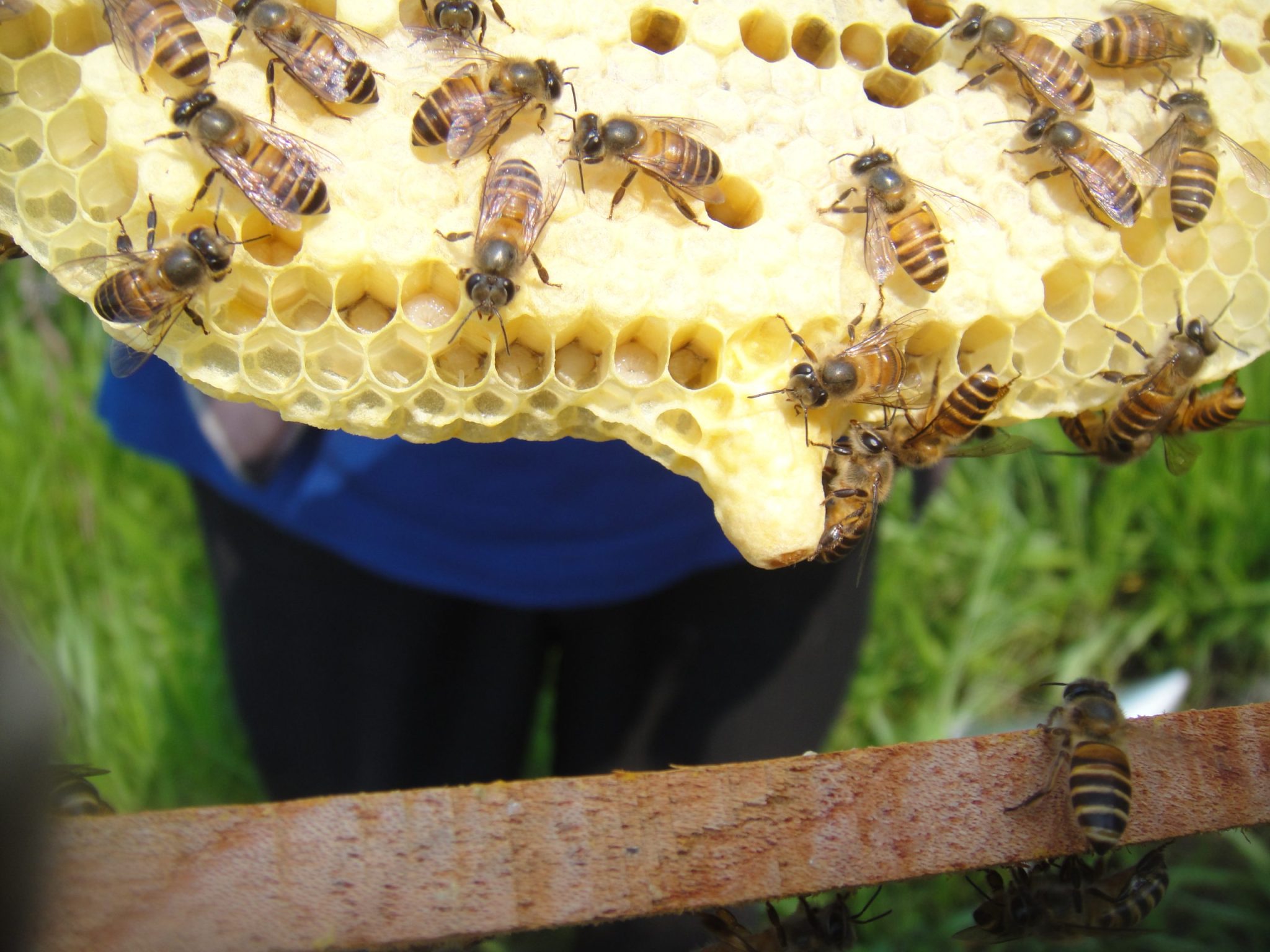
- Queen cells, especially along the bottom edges and sides of frames, containing eggs or larvae. These are swarm cells.
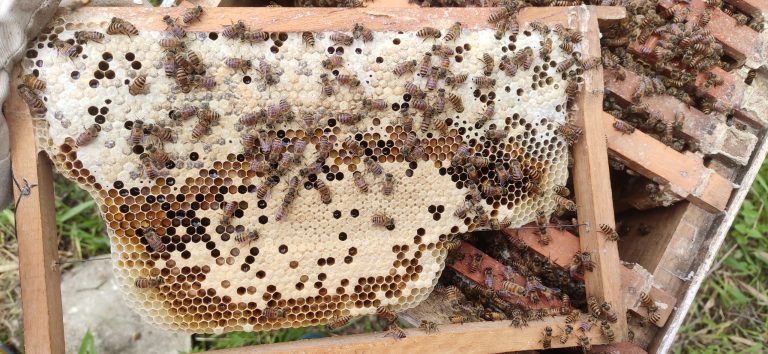
- Crowded frames, with bees covering every frame and brood or honey filling every cell.
- Fewer eggs: the queen slows down so she is light enough to fly.
- Bees hanging in clusters outside the entrance on warm days, with little foraging.
If you find capped queen cells, a swarm may be only days away, or may already have left.
How to prevent swarming
- Inspect regularly in spring: every 7–10 days. See How to Inspect a Beehive.
- Give space before it’s needed. Add frames with foundation or a honey box while the colony still has some room.
- Keep young queens. Colonies headed by queens in their first year are less likely to swarm.
- Make a split. If a colony is building swarm cells, divide it: move the old queen with some frames of brood, food and bees into a new hive, and leave the original colony with queen cells to raise a new queen. You’ve got two colonies instead of losing a swarm.
Just destroying queen cells rarely works. The colony is set on swarming and will often build more, or swarm anyway, leaving you with no queen. Splitting the colony is more reliable.
How to catch a swarm
Swarms are usually gentle: the bees are full of honey and have no home to defend. Still, wear your veil and take care.
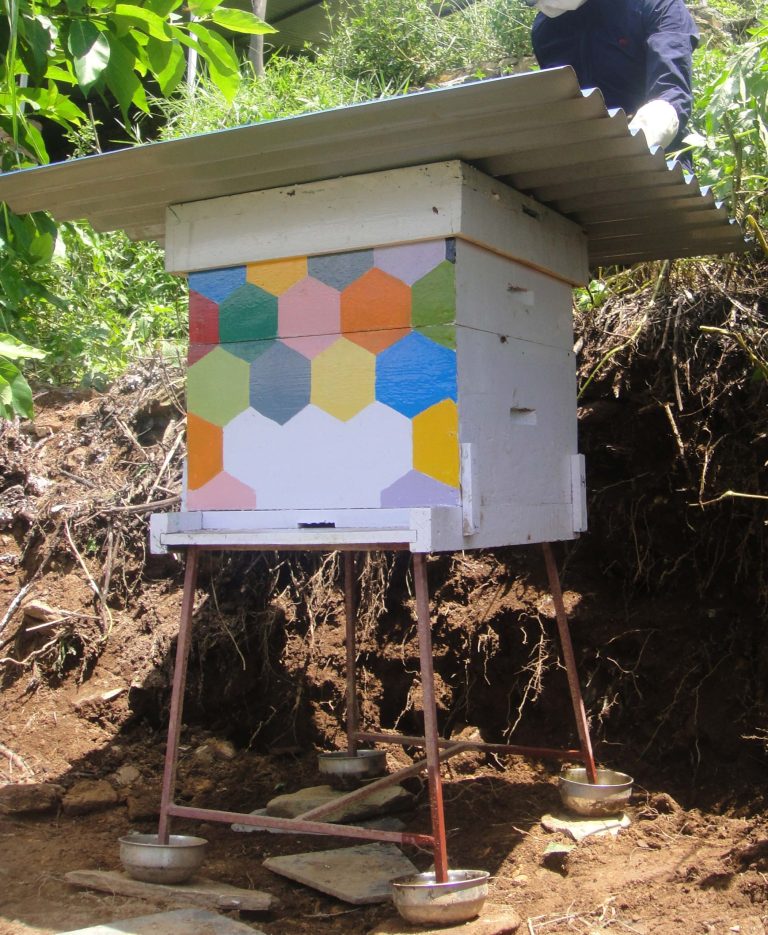
- Prepare a box or hive with a few frames, ideally including one old, empty comb, which smells like home.
- Hold the box under the cluster and give the branch one sharp shake so the bees drop in. For clusters on walls or thick branches, brush or scoop them gently.
- Look for the queen going in, or watch the bees. If they fan at the entrance with raised abdomens, releasing a homing scent, the queen is in the box.
- Leave the box nearby until dusk, so stragglers can join, then move it to its new site.
- Give the swarm frames to draw out and, if no nectar is coming in, feed it for a few days.
Never try to collect swarms from dangerous heights or near power lines. Call for experienced help.
Swarming vs absconding
Absconding looks similar but is very different. Instead of half the colony leaving to reproduce, the whole colony abandons the hive, often leaving empty comb behind. It’s a response to bad conditions: lack of food, repeated disturbance, heat, pests such as wax moth or hornets, or disease.
Absconding is especially common in the Asian honeybee, Apis cerana. To reduce it:
- Keep colonies well fed during dearth periods.
- Inspect gently and not too often.
- Keep hives shaded, dry and protected from pests.
- Place a small piece of queen excluder over the entrance of newly hived colonies for a few days, so the queen can’t leave while they settle.
Read more about how cerana and mellifera behave differently in Apis cerana vs Apis mellifera.
The swarm’s democracy
Once a swarm leaves the hive, hundreds of scout bees search for a new home, such as a hollow tree or a wall cavity, and come back to “dance” for the best sites. Gradually, more scouts back the best option until they reach a consensus, and the whole swarm flies off together. Find out how bees dance in The Waggle Dance.