Key takeaways
- Foragers that find a rich food source come home and perform a waggle dance on the comb.
- The angle of the dance shows the direction of the flowers relative to the sun; the length of the waggle shows the distance.
- For flowers very close to the hive, bees use a simpler round dance.
- Bees also communicate with scent, food sharing, vibrations and special dances when choosing a new home.
How does a colony of tens of thousands of bees find the best flowers within kilometres of its hive? Part of the answer is one of the most famous discoveries in animal behaviour: honeybees dance to tell their sisters where to go.
The Austrian scientist Karl von Frisch spent decades decoding this “dance language”, work that earned him a share of the Nobel Prize in 1973.
The round dance: “food nearby”
When a forager finds a good source close to the hive, within roughly 50–100 metres, she runs in small circles on the comb, reversing direction every turn or two. Other bees follow her, smell the flower scent on her body and taste the nectar she shares. Then they search nearby.
The waggle dance: direction and distance
For flowers further away, the forager performs a waggle dance, a figure-of-eight:
- She runs straight forward a short distance while waggling her abdomen rapidly from side to side. This is the waggle run.
- She circles back to the start, alternately to the left and the right, and repeats the waggle run, often dozens of times.
The waggle run carries two pieces of information.
Direction
Inside the dark hive, bees dance on the vertical surface of the comb, and they use gravity as a stand-in for the sun:
- Waggling straight up the comb means “fly towards the sun”.
- Waggling straight down means “fly away from the sun”.
- Waggling at an angle, say 60° to the right of vertical, means “fly 60° to the right of the sun”.
Bees even adjust for the sun’s movement across the sky during the day.
Distance
The longer the waggle run, the further away the food. Roughly speaking, each second of waggling represents around a kilometre of flight, though the exact “calibration” differs between bee populations and species. Bees appear to measure distance by how much scenery flows past their eyes in flight.
Quality
A forager that found a particularly rich source dances more enthusiastically and repeats her dance more times, so more recruits go to the best flowers. In this way the colony shifts its workforce to the most profitable patches without any bee being in charge.
How Nepal’s honeybees dance
All honeybees dance, but in slightly different ways that match how they nest (see The Bees of Nepal):
- Asian and European honeybees (Apis cerana and Apis mellifera) dance in the dark on vertical combs, using gravity in place of the sun as described above.
- The giant honeybee (Apis dorsata) dances in the open on the curtain of bees covering its comb.
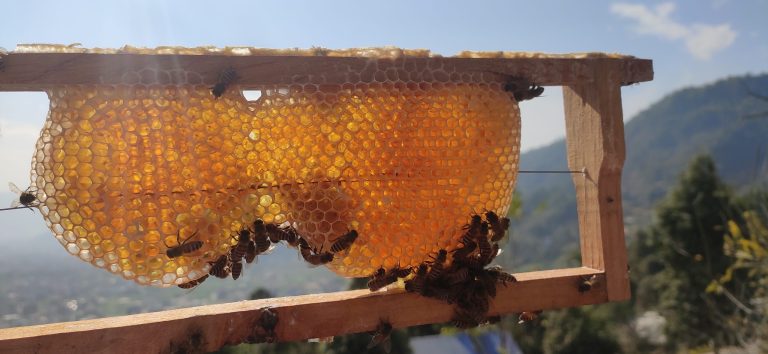
- The dwarf honeybee (Apis florea) dances on the flat top of its comb, which wraps around a twig. It points its waggle run directly towards the food, with no need to translate the sun’s direction into gravity.
Other ways bees communicate
Dances aren’t the only messages passing through a hive:
- Scent: foragers carry flower scents home, and the queen and workers release pheromones that signal alarm, mark the entrance and hold the colony together.
- Food sharing: constant mouth-to-mouth food passing spreads information about what is coming in, and how much.
- The tremble dance: when foragers have to wait too long to unload nectar, they shake and tremble across the comb, recruiting more bees to work as receivers.
- The stop signal: a short buzz and head-butt that can discourage dancers advertising a dangerous or crowded site.
- House-hunting dances: when a swarm needs a new home, scout bees dance for the cavities they’ve found. The scouts reach a consensus, almost a vote, before the swarm flies to its new home. Read more in Swarming.
Watch it yourself
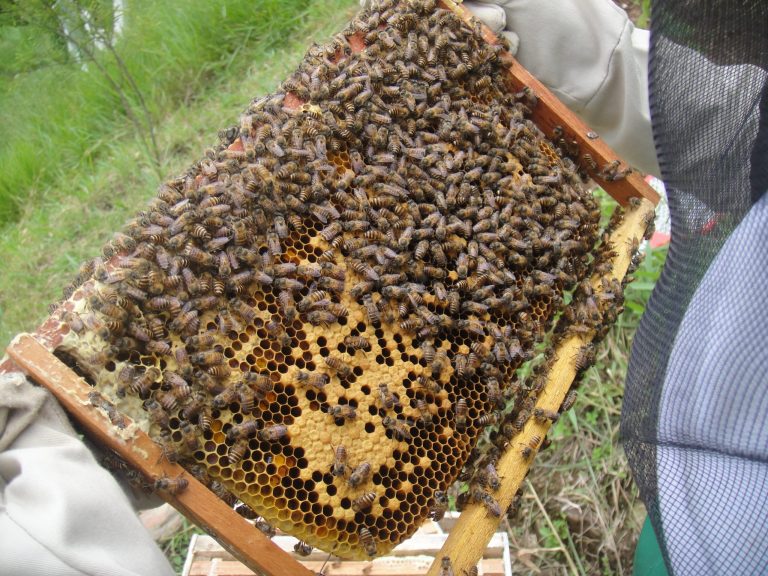
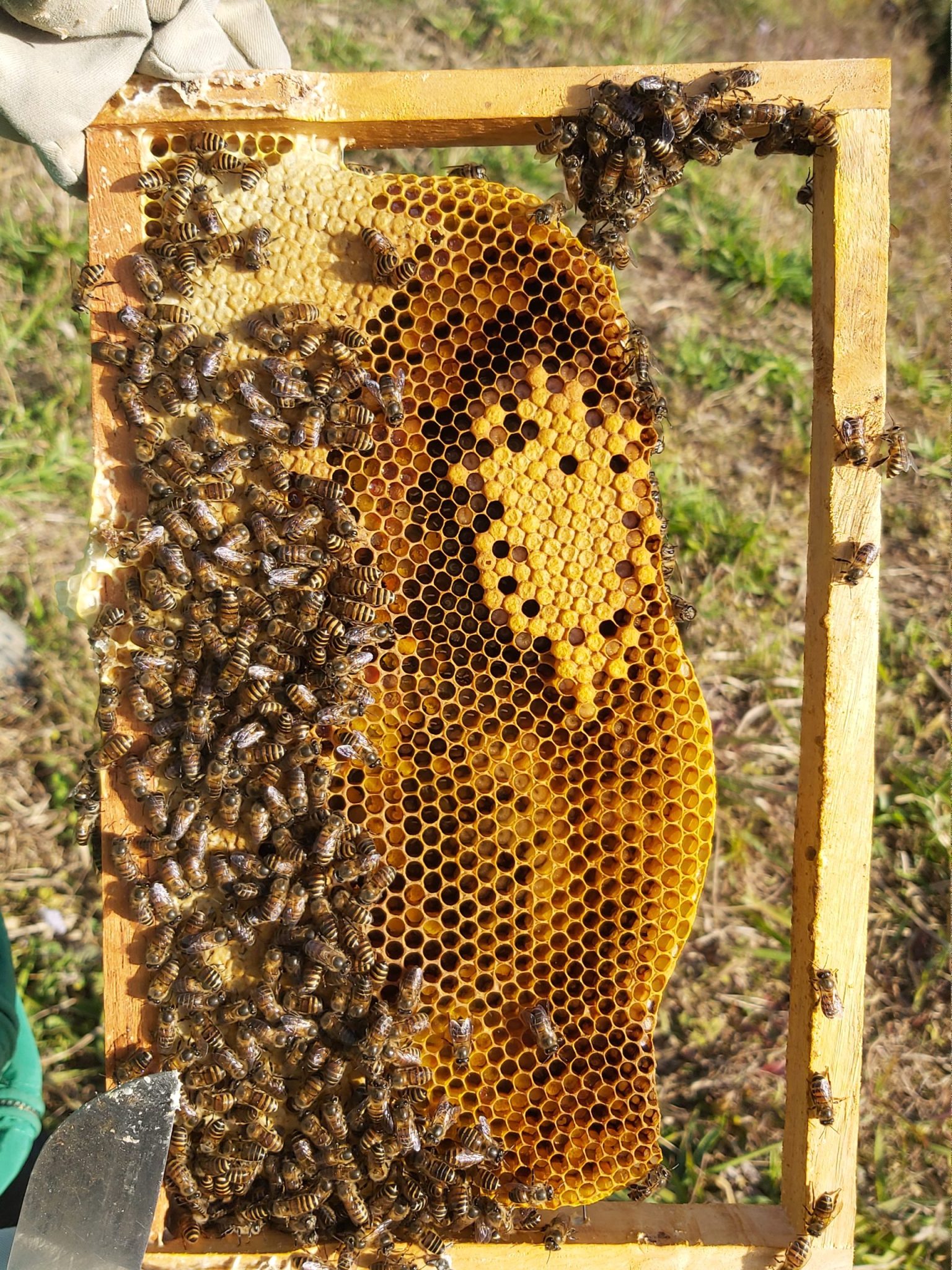
If you keep bees, try this on a warm day during a good flow: lift a frame from near the entrance, hold it upright in the sun and look closely. You’ll often see bees in a little crowd, following a dancer as she repeats her waggle runs. It’s one of the most fascinating sights in beekeeping.
Sources and further reading
- von Frisch, K. (1967). The Dance Language and Orientation of Bees. Harvard University Press.
- Seeley, T.D. (1995). The Wisdom of the Hive. Harvard University Press.
- Seeley, T.D. (2010). Honeybee Democracy. Princeton University Press.