
Key takeaways
- Honey is made from nectar, a sugary liquid that is mostly water when bees collect it.
- Bees add enzymes that break down sugars and help preserve the honey.
- They evaporate the water by fanning until honey is about 17–18% water, then seal each cell with wax.
- A single worker makes only about a twelfth of a teaspoon of honey in her lifetime, so every jar is the work of thousands of bees.
A spoonful of honey looks simple, but it is the end product of one of nature’s most remarkable food-processing operations. Thousands of bees, working in relay, turn thin flower nectar into a thick, stable food that can keep for years.
Step 1: Collecting nectar
Flowers produce nectar to attract pollinators. It is mostly water with dissolved sugars, mainly sucrose, glucose and fructose, along with tiny amounts of amino acids, minerals and aromatic compounds that later give each honey its flavour.
A forager bee sucks up nectar with her long, tube-like tongue and stores it in her honey stomach (crop), a special pouch separate from her digestive stomach. She may visit dozens to hundreds of flowers before her load is full and she flies home. While she flies, she is already adding enzymes to the nectar.
Step 2: Passing it on
Back at the hive, the forager doesn’t store the nectar herself. She passes it mouth-to-mouth to younger receiver bees working inside the hive. This sharing, called trophallaxis, lets foragers get straight back to work, and every transfer mixes in more enzymes.
Step 3: Adding enzymes
Two enzymes from the bees’ glands do most of the work:
- Invertase splits sucrose (table sugar) into glucose and fructose. These simpler sugars make honey sweeter, more stable and harder for microbes to use.
- Glucose oxidase turns a little of the glucose into gluconic acid and hydrogen peroxide. This makes honey slightly acidic and helps protect it from spoiling while it ripens.
Step 4: Drying it down
Fresh nectar is far too watery to store; it would ferment. Receiver bees spread droplets in open cells, repeatedly working them on their tongues to expose them to the air. Meanwhile, bees across the hive fan their wings to drive warm, moist air out of the entrance. On a warm evening during a strong flow, you can often hear this humming and smell the nectar from outside the hive.
Over a few days the water content drops from well over 50% to around 17–18%. At that point honey holds so much sugar and so little water that yeasts and bacteria can’t grow in it.
Step 5: Capping and storing
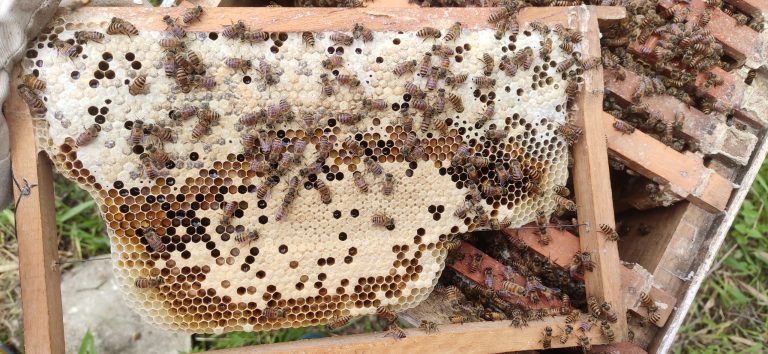
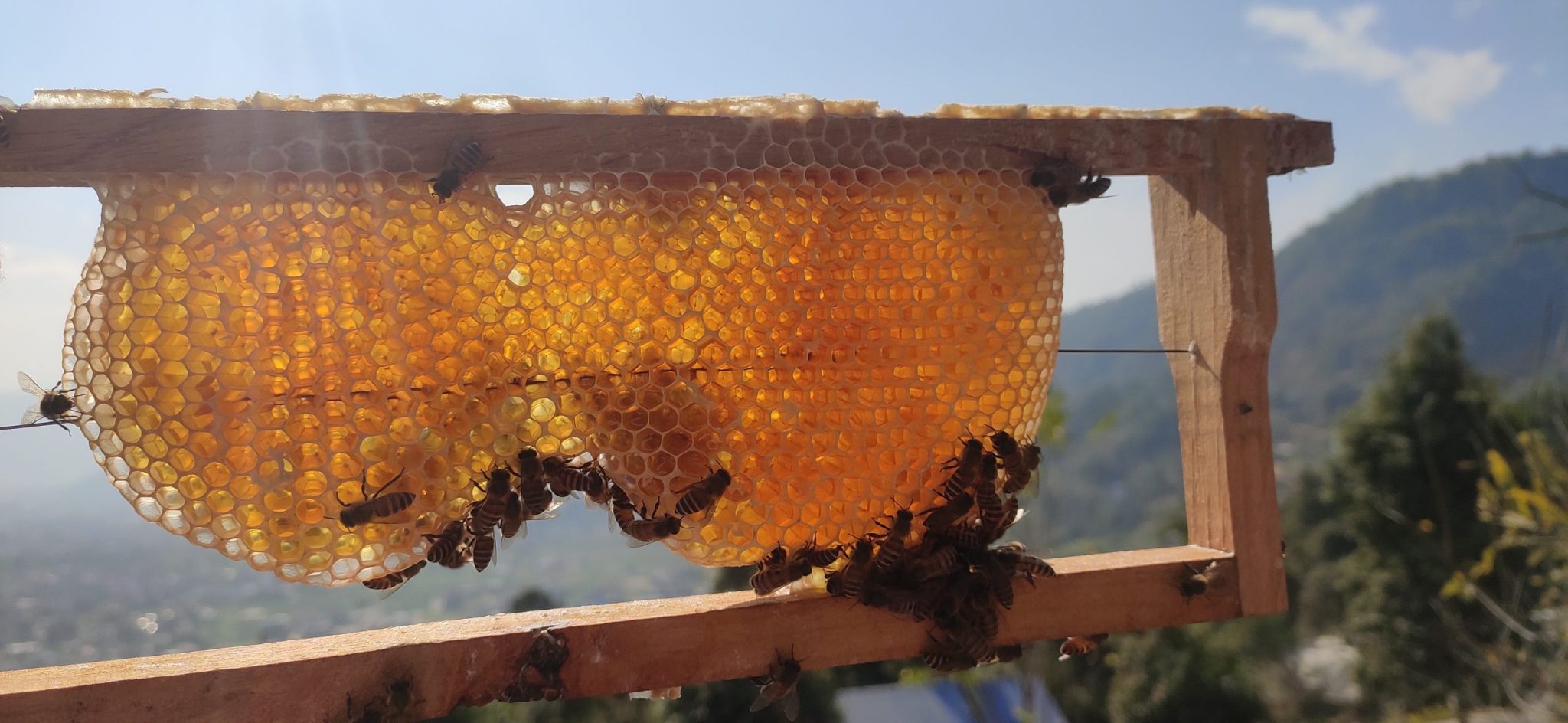
When a cell is full of ripe honey, the bees seal it with a thin cap of fresh white beeswax. Capped honey is the colony’s food store for times when no flowers are in bloom: the monsoon, cold spells and winter in the hills.
Beekeepers use this as a guide: honey is usually ready to harvest when most of a frame is capped. Harvesting unripe, uncapped honey risks fermentation. See Harvesting Honey the Right Way.
Why each honey is different
The flowers make the honey. Nectar from different plants has different sugar balances and aromas, which is why:
- mustard honey is pale, mild and crystallises within days or weeks,
- buckwheat honey is dark and strongly flavoured,
- multifloral honey changes from season to season and place to place.
Find out what flowers when in Nepal’s Honey Calendar, and why some honeys turn solid in Why Does Honey Crystallise?
A little honey from a lot of bees
In the busy season, a worker bee lives only about five to six weeks, and she spends only the last two to three weeks foraging. In her lifetime she produces roughly a twelfth of a teaspoon of honey. A single jar is the combined work of thousands of bees making many thousands of flights.
It’s also worth remembering that honey isn’t made for us. It’s the colony’s food. Good beekeepers only take the surplus and always leave the bees enough to live on.
Sources and further reading
- Winston, M.L. (1987). The Biology of the Honey Bee. Harvard University Press.
- Crane, E. (1990). Bees and Beekeeping: Science, Practice and World Resources. Heinemann Newnes.