
Key takeaways
- Honey hunting is a centuries-old tradition in Nepal’s hills, practised by communities such as the Gurung and Kulung Rai.
- Hunters harvest combs of the Himalayan cliff bee (Apis laboriosa) from sheer cliffs, using rope ladders, long poles and smoke.
- Spring cliff honey can contain grayanotoxins from rhododendron nectar, the source of “mad honey”, and must be treated with care.
- Habitat change, overharvesting and commercial pressure threaten both the bees and the tradition. Responsible harvesting keeps both alive.
On the cliffs above some of Nepal’s river valleys hang great half-moon combs, each up to a metre or more across, covered in a living curtain of bees. They belong to the Himalayan cliff bee, Apis laboriosa, the largest honeybee in the world. For generations, people in the hills have risked their lives to harvest them.
Who are the honey hunters?
Honey hunting has been practised in Nepal for centuries, especially among Gurung communities in the central hills, in districts such as Lamjung and Kaski, and among the Kulung Rai of the eastern hills in Solukhumbu. In each community, honey hunting is bound up with local knowledge, ritual and social life: which cliffs belong to which village, who may harvest, and how the honey is shared.
The harvest
Harvests traditionally take place once or twice a year, often in late spring and in autumn. Details differ between communities, but the main steps are similar:
- Ritual. Before the harvest, many communities make offerings and prayers to the deities of the cliff and forest, asking for safety and a good harvest.
- Smoke. Fires of grass and leaves are lit at the foot of the cliff. The smoke drifts up the rock face and drives bees away from the combs.
- The climb. A lead hunter descends the cliff on a long ladder of rope or bamboo, often with a safety line, hanging high above the ground while bees swirl around him.
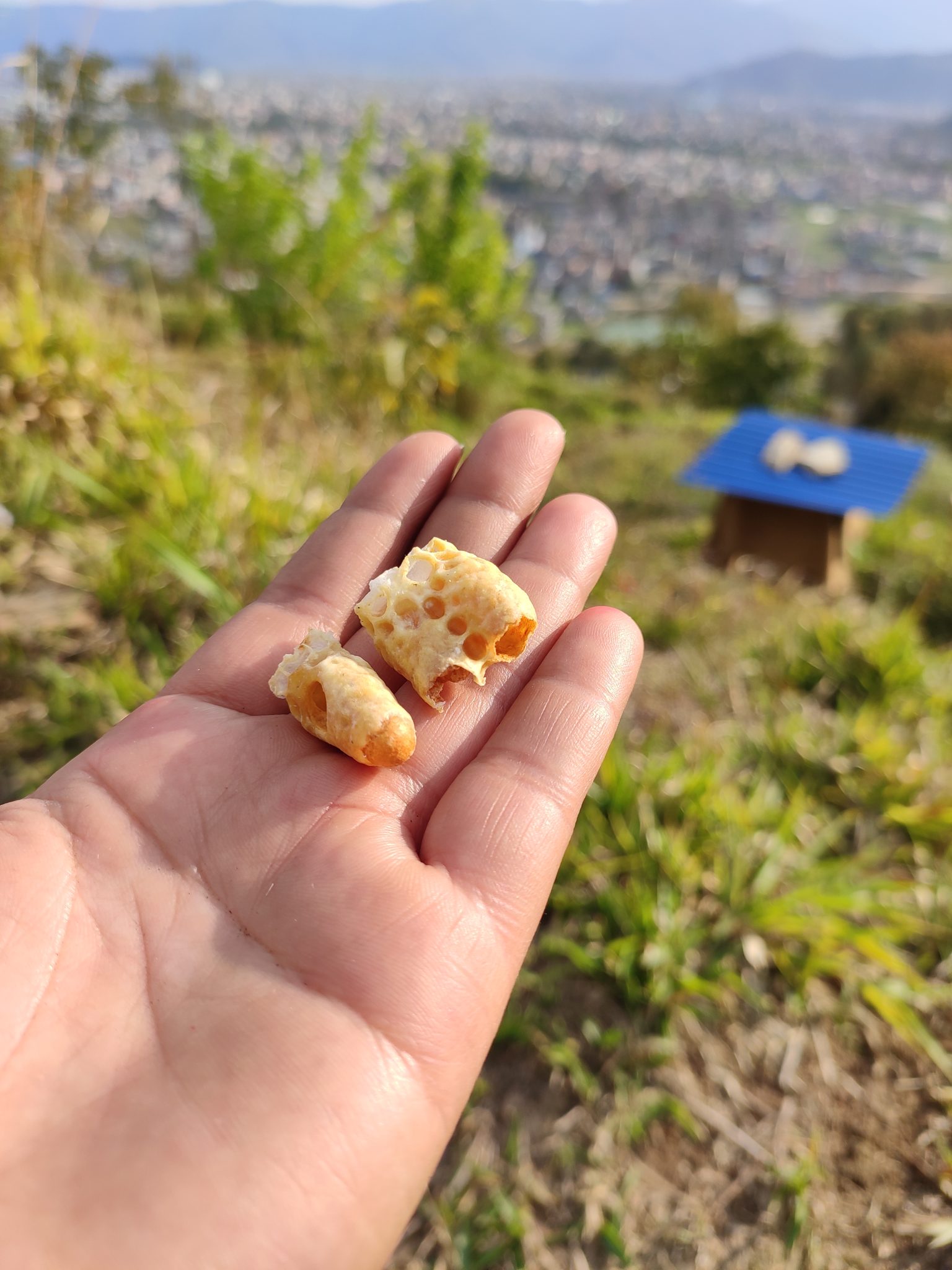
- Cutting the comb. Using long poles, the hunter cuts away sections of comb, honey and wax, which are caught in a basket lowered on a rope.
- Sharing. The honey is divided among the team and the community, used at home, and increasingly sold.
It is extremely dangerous work: falls, mass stings and exhaustion are all real risks, and the skills are passed on through years of experience.
About “mad honey”
In spring, when rhododendrons bloom in the mountains, cliff bees collect nectar that can contain grayanotoxins. Honey from this season can therefore be “mad honey”, which in small amounts causes dizziness and in larger amounts can lead to vomiting, very low blood pressure and a slow heart rate requiring hospital care. The toxin level is unpredictable from comb to comb.
Mad honey is increasingly sold abroad, sometimes marketed for its effects. We believe that’s irresponsible: honey sold as food must be safe, tested and honestly labelled. Read our news piece, European Alert on Nepali “Mad Honey”.
Pressures on the tradition
Honey hunters and researchers have raised several concerns:
- Fewer colonies. In some areas, people report fewer and smaller cliff-bee colonies than in the past, linked to habitat loss, changing climate and more frequent harvesting.
- Commercial demand. Rising prices for cliff honey, and for mad honey in particular, can encourage harvesting too often or taking whole combs, including brood.
- Tourism. “Honey hunting tours” bring income, but harvests staged for visitors can disturb colonies and add pressure if not carefully managed.
- Losing knowledge. As young people move to cities or abroad, fewer learn the skills, rituals and rules that kept harvesting in balance.
Harvesting responsibly
Traditional practice often included rules that protected the bees, and modern conservation advice builds on them:
- Harvest only some of the combs on a cliff, and leave others untouched.
- Leave the brood part of the comb, where young bees develop, so the colony can recover.
- Limit how often each cliff is harvested.
- Protect the forests and flowers around nesting cliffs.
- Make sure local honey hunters are fairly paid and involved in decisions about their cliffs.
Why it matters
The Himalayan cliff bee is an important pollinator in mountain ecosystems, where few other honeybees can survive. And honey hunting is part of Nepal’s living cultural heritage. With care, both can continue for generations to come.
Learn more about this remarkable bee and its relatives in The Bees of Nepal.
Sources and further reading
- ICIMOD publications on honey hunting and Apis laboriosa in the Hindu Kush Himalaya.
- Oldroyd, B.P. and Wongsiri, S. (2006). Asian Honey Bees: Biology, Conservation, and Human Interactions. Harvard University Press.