
Key takeaways
- For centuries, Nepalis harvested honey from wild cliff and tree colonies and kept the native Asian honeybee in log and wall hives.
- Government support for modern beekeeping grew from the 1980s, and movable-frame hives gradually replaced traditional ones.
- The European honeybee arrived in the early 1990s, transforming beekeeping into a commercial industry centred on the Terai.
- Today Nepal produces around 6,000 tonnes of honey a year, with potential for far more.
Honey has been part of life in Nepal for as long as anyone can remember: in food and medicine, in religious rituals, and in the traditions of the hills. But the way Nepalis get their honey has changed dramatically, especially in the last forty years.
Honey hunters and wild bees
The oldest form of honey gathering in Nepal is honey hunting: harvesting combs from wild colonies of the giant honeybee in the lowlands, and of the Himalayan cliff bee on mountain cliffs. Communities such as the Gurung and Kulung Rai developed elaborate skills, rituals and rules around the harvest, which continue today. Read more in Honey Hunting in Nepal.
Traditional beekeeping: log and wall hives
Alongside honey hunting, farmers in the hills have long kept the native Asian honeybee (Apis cerana) close to home:
- in hollow logs hung under the eaves or placed near the house,
- in wall hives, cavities built into the thick walls of village houses with a small entrance to the outside,
- and in baskets, pots and boxes.
Honey from these hives was harvested by cutting combs from the back of the hive, often once or twice a year. It was used at home, given as gifts, and used in rituals: honey is one of the five ingredients of panchamrit, offered in Hindu worship. These traditional methods are still practised in remote areas today.
Modern beekeeping arrives
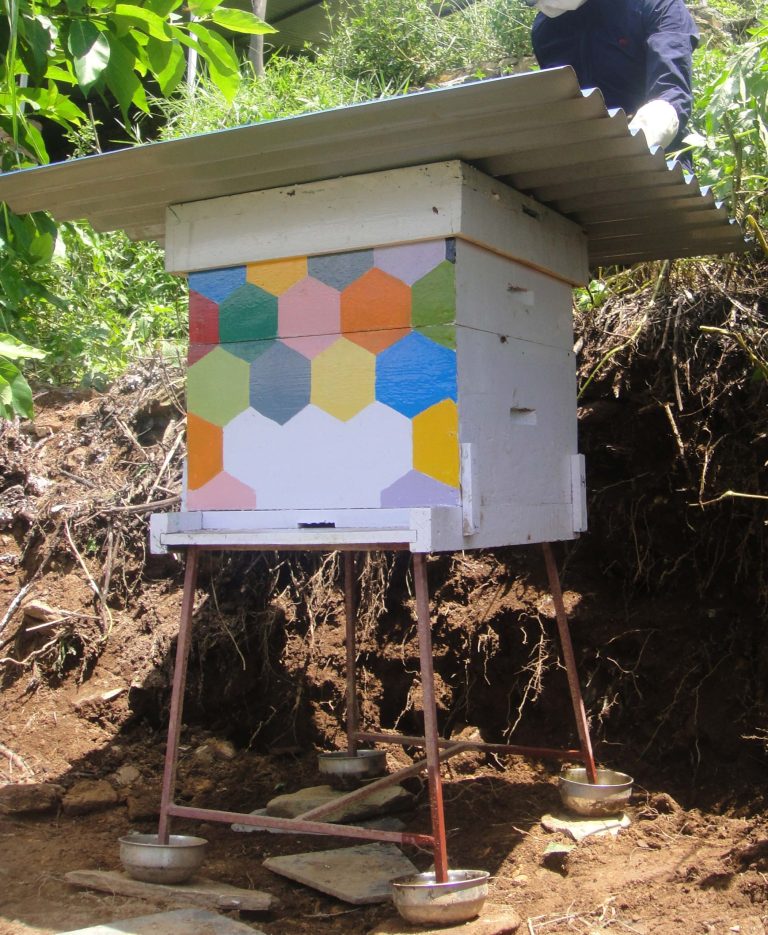
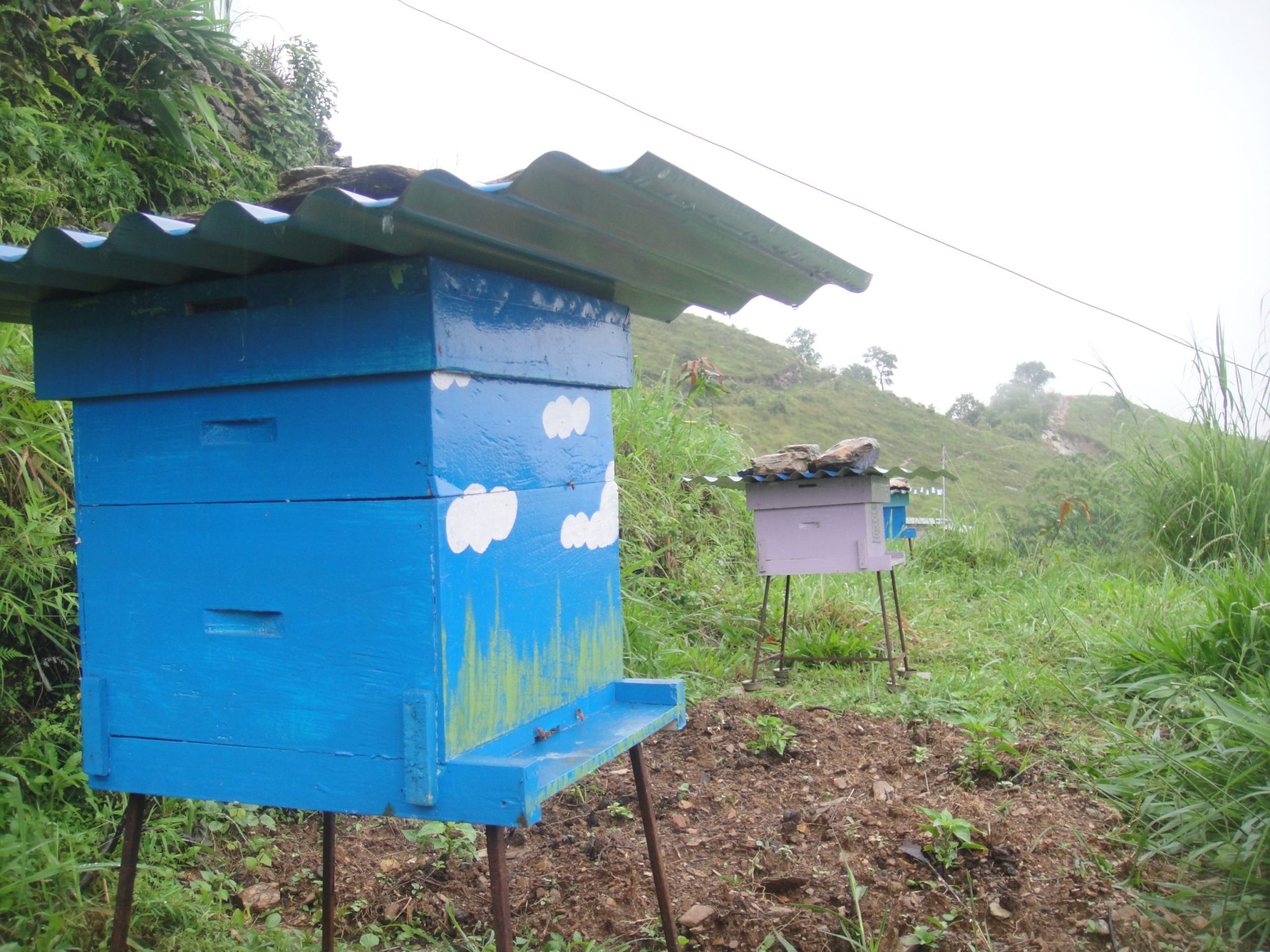
In the second half of the 20th century, beekeepers began to adopt movable-frame hives, in which each comb is built in a removable wooden frame. Frame hives allow beekeepers to inspect colonies, manage swarming and disease, and harvest honey without destroying the combs. Smaller frame hives were developed for Apis cerana.
Government support for beekeeping grew from the 1980s, when a dedicated office for beekeeping development was established at Godawari in Lalitpur. It was later moved to Bhandara in Chitwan, where the climate is better suited to bees; today it operates as the Beekeeping Development Centre. Development organisations and research institutions also studied and promoted Nepal’s native honeybees during this period.
The European honeybee and commercial beekeeping
In the early 1990s, the European honeybee (Apis mellifera) was introduced to Nepal from India. Its arrival came at a difficult time: Thai sacbrood virus was causing heavy losses of Apis cerana colonies across South Asia, including Nepal.
Mellifera‘s large colonies and high yields transformed beekeeping. Commercial apiaries grew rapidly, especially in the Terai and inner Terai, around the vast winter mustard fields of districts such as Chitwan, along with Dang, Jhapa, Morang and others. Migratory beekeeping, moving hives to follow the flowers, became common. See Migratory Beekeeping in Nepal.
Meanwhile, many hill farmers continued to keep Apis cerana, which is better adapted to the mountains. Today both bees have important roles. See Apis cerana vs Apis mellifera.
Growth and recognition
In recent years, beekeeping has become an established part of Nepal’s agricultural economy:
- Government programmes, including bee zones under the Prime Minister Agriculture Modernisation Project from 2017, supported commercial beekeepers in key districts.
- Beehive insurance, with most of the premium paid by the government, became available.
- Honey was named a priority export in the Nepal Trade Integrated Strategy 2023, and Nepal exported about 10 tonnes of honey in 2023/24.
- By 2025, Nepal was producing around 6,000 tonnes of honey a year, according to the Federation of Beekeepers Nepal, with about 115,000 hives held by registered commercial beekeepers alone.
- In April 2026, Nepal hosted its first International Beekeeping Conference at the Agriculture and Forestry University in Chitwan.
A timeline
| When | What happened |
|---|---|
| Centuries ago to today | Honey hunting from wild cliff and tree colonies; Apis cerana kept in log and wall hives |
| Mid–late 20th century | Movable-frame hives introduced |
| 1980s | Dedicated government beekeeping development office set up at Godawari, Lalitpur, later moved to Bhandara, Chitwan |
| 1980s–1990s | Thai sacbrood virus causes heavy losses of Apis cerana |
| Early 1990s | European honeybee (Apis mellifera) introduced; commercial beekeeping grows in the Terai |
| 2017 | Prime Minister Agriculture Modernisation Project begins, including bee zones |
| 2023 | Honey named a priority export in the Nepal Trade Integrated Strategy |
| 2025 | National production around 6,000 tonnes a year |
| 2026 | First International Beekeeping Conference held in Chitwan |
Challenges today
Nepal’s beekeepers still face serious challenges:
- Climate and weather: unseasonal rain and shifting flowering seasons, as in Chitwan in 2026 (read more).
- Pests and diseases: mites, sacbrood and hornets. See Pests and Diseases.
- Markets: low prices paid by traders, adulterated honey, and disputes over honey imports.
- Wild bees: pressure on cliff bee colonies and loss of forest habitat.
Looking ahead
The Federation of Beekeepers estimates that Nepal’s flowers could support up to 30,000 tonnes of honey a year, five times today’s production. Realising that potential sustainably will depend on protecting forests and wild bees, training new beekeepers, building trust in Nepali honey through testing and honest labelling, and keeping alive the traditions that make Nepali honey unique.
Find out more about the government programmes supporting beekeepers today in Government Support and Training.
Sources and further reading
- Devkota, K. (2020). Beekeeping: Sustainable Livelihoods and Agriculture Production in Nepal. IntechOpen.
- Bees and Beekeeping in Nepal, ResearchGate.
- Problems of Bee Keeping in Nepal and Way Forward, ResearchGate.
- Nepal’s annual honey production around 6,000 metric tonnes, Khabarhub, November 2025.
- Bee-keepers want 50 ton sugar at subsidized rates, myRepublica.